Professor Michael Short
Reading Time
SHARE
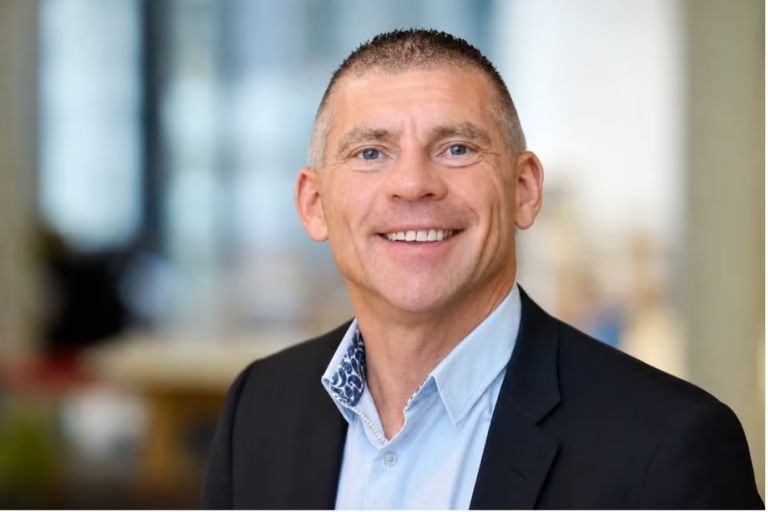
Engineering the Future Through AI, Sustainability, and Human-Centred Innovation
In an era where artificial intelligence, robotics, and sustainability are reshaping industries at an unprecedented pace, few leaders have successfully bridged the gap between cutting-edge research and practical industrial transformation as effectively as Professor Michael Short. As Associate Dean and Director of the Centre for Sustainable Engineering at Teesside University, Professor Short has dedicated his career to ensuring that technological innovation delivers measurable benefits for society, industry, and future generations.
His journey is a compelling testament to the power of curiosity, lifelong learning, and a steadfast commitment to solving real-world challenges through science and engineering.
A Passion That Began with Curiosity
For Professor Short, the foundations of his career were laid long before entering university. Growing up during the 1980s, he developed an early fascination with electronics, computers, and understanding how complex systems worked. Programming on a Sinclair ZX Spectrum and experimenting with early robotics kits ignited a passion that would eventually evolve into a distinguished career in electrical and electronic engineering, artificial intelligence, control systems, and robotics.
That childhood curiosity eventually led him to doctoral research, where he designed and built a fully functioning robotic manipulator integrated with an advanced AI-based control system. While artificial intelligence has evolved dramatically since those early years, the mission has remained remarkably consistent – developing intelligent systems capable of learning, adapting, and supporting better human decision-making.


Turning Research into Real-World Impact
Throughout his academic career, Professor Short has consistently challenged the notion that research should remain confined to laboratories or academic journals. His philosophy is clear: meaningful research should create tangible value for organisations, communities, and society.
This belief has shaped collaborations across manufacturing, healthcare, energy, construction, infrastructure, and sustainability, where emerging technologies are transformed into practical solutions addressing real operational challenges.
His international engagements across Africa, India, Malaysia, China, the Gulf, and other regions have further reinforced the universal importance of sustainability, digital transformation, and workforce development. These experiences continue to influence his approach to creating globally relevant engineering solutions.
Today, Professor Short’s work focuses on the convergence of artificial intelligence, sustainability, and industrial transformation. His projects include developing AI-enabled facility management systems using computer vision, IoT sensing, and intelligent analytics to improve operational efficiency, HVAC effectiveness, and ancillary services such as cleaning, catering, security, and waste management. In collaboration with global organisations – including ADNOC, and the NHS – he has also explored how these methods can support ambitious sustainability objectives across different sectors and types of infrastructure.
Beyond academia, he also works as consultant for Bart’s Health Trust in London, helping to guide their and Green and Digital Transformation. He also works with Bramham Innovations, USA, helping accelerate the commercialisation of emerging engineering and sustainability technologies, ensuring that groundbreaking research reaches industries where it can make a lasting impact.
Building a Legacy Beyond Personal Achievement
While Professor Short has published more than 200 research papers spanning artificial intelligence, robotics, sustainable manufacturing, energy systems, and control engineering, he views publications as only the beginning of innovation – not its destination.
Among the milestones he values most is successfully bridging academic excellence with industrial implementation. His leadership in AI-enabled digital transformation initiatives has demonstrated how intelligent technologies can support healthcare professionals, improve industrial operations, and accelerate sustainability efforts across multiple sectors.
Achieving a Professorship in 2020 marked a defining moment in his professional journey, but perhaps even more meaningful has been the opportunity to mentor researchers, educate future engineers, and inspire the next generation of innovators. Watching former students emerge as successful researchers, entrepreneurs, and engineering leaders remains one of his greatest professional rewards.
His contributions have earned significant recognition, including being named in the UK’s Net Zero 50 list in both 2023 and 2025, alongside induction into the IEEE Technical Committee on Factory Automation in 2012, and IEEE Eta Kappa Nu (IEEE-HKN) society in 2026, honouring his leadership, professional excellence, and service to the engineering community. Yet, Professor Short credits these achievements to the outstanding students, colleagues, and industrial partners who have contributed throughout his journey.


Leading the Transition Towards Industry 5.0
Looking ahead, Professor Short believes the world is entering one of the most transformative technological eras since the Industrial Revolution. While artificial intelligence continues to dominate headlines, he sees the true revolution emerging from the convergence of AI, robotics, sustainable energy, and human collaboration.
He envisions a future where digital transformation and green transformation become inseparable, enabling organisations to improve productivity while simultaneously reducing environmental impact. As traditional energy resources decline, intelligent systems will become essential for balancing competitiveness with sustainability.
Central to this vision is Industry 5.0 – an era where technology complements human capability rather than replacing it. Engineers, clinicians, operators, and business leaders will increasingly work alongside intelligent systems that analyse complex data, provide evidence-based insights, and empower better decisions. Artificial intelligence, in his view, is at its most valuable when it amplifies human creativity, judgement, and innovation.
Through Teesside University, Professor Short continues to advance and co-ordinate research in sustainable engineering, smart manufacturing, digital healthcare, industrial decarbonisation, circular economy, and digital trade. Working alongside industry and professional organisations, he remains committed to helping businesses implement practical technologies that deliver measurable operational and environmental benefits.
Empowering the Next Generation of Leaders
For aspiring professionals, Professor Short offers advice rooted in decades of experience: remain curious, adaptable, resilient, and committed to the purpose behind your profession.
He encourages young engineers and professionals not to fear emerging technologies such as AI, robotics, or clean energy, but instead to understand, master, and responsibly harness them. According to him, the future belongs to those who combine technical expertise with creativity, ethics, communication, and a deep understanding of human needs.
Equally important is collaboration. Many of his most impactful projects have succeeded because they united engineers and computer scientists with other key stakeholders: including clinicians, policymakers, lawyers, manufacturers, and facilities managers around shared challenges. For Professor Short, innovation flourishes where disciplines intersect and diverse perspectives come together.
His philosophy on leadership is equally inspiring. Leadership is not about having every answer – it is about creating a shared vision, empowering talented individuals, fostering experimentation, and building environments where people can succeed together. Purpose, integrity, adaptability, and lifelong learning, he believes, remain the defining qualities of impactful leadership.

Shaping a Smarter, More Sustainable Tomorrow
From a young boy fascinated by early robotics to an internationally recognised professor leading transformative work in artificial intelligence and sustainable engineering, Professor Michael Short’s career exemplifies how curiosity can evolve into lasting global impact.
His unwavering commitment to translating research into practical solutions, empowering future leaders, and advancing technologies that serve humanity continues to shape industries and communities worldwide. As the world embraces the next generation of intelligent, sustainable systems, Professor Short remains at the forefront – demonstrating that the greatest innovations are those that improve lives, strengthen society, and create a cleaner, smarter future for all.